Auto Repair Shop In Plainfield, IL

A modern car garage repair business depends on more than skilled hands. It needs accurate lifts, reliable diagnostic scanners, safe tire machines, and equipment that survives daily pressure. S&P Global Mobility reported that the average age of vehicles in the United States reached about 12.6 years in 2024. Older vehicles create steady demand for inspection, maintenance, and repair services. They also expose weak equipment quickly.
The Auto Care Association’s 2024 Joint Channel Forecast valued the U.S. automotive aftermarket at more than $500 billion. That scale reflects opportunity, but it also raises standards. Equipment suppliers must provide calibration support, training, spare parts, warranty service, and clear technical documentation. ASE former president and CEO Michael Cole has noted, “Today’s vehicles are complex systems, not just mechanical machines.” His point matters. A basic code reader may not support advanced driver-assistance systems, hybrid vehicles, or secure gateway access.
Performance matters.
This guide reviews 10 best car garage repair equipment suppliers through a practical lens. It considers product range, technician support, safety features, service coverage, software updates, and long-term value. A low purchase price can become expensive when a lift remains unused or a scanner loses coverage. Still, no supplier is perfect. Some companies excel in diagnostics but offer limited workshop hardware. Others provide strong equipment but weaker after-sales support. Reported specifications may also vary by region and model year. Readers should verify certifications, installation requirements, local service availability, and total ownership costs before buying. That caution may seem slow. In a real workshop, it prevents costly surprises.
Understanding Car Garage Repair Equipment Suppliers
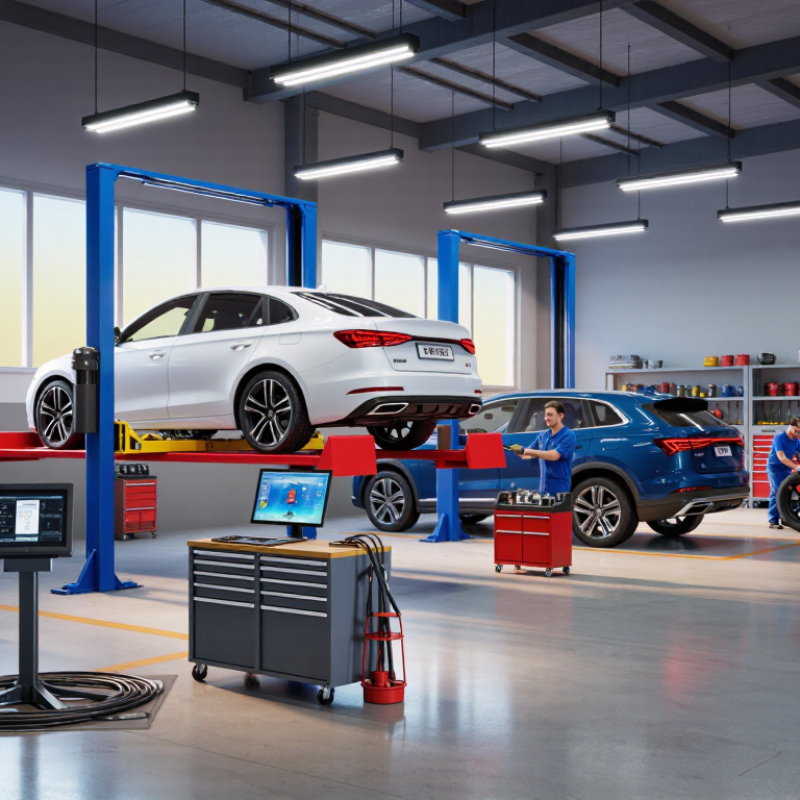
Car garage repair equipment suppliers do more than deliver lifts, compressors, and diagnostic tools. They shape daily safety, workflow, and repair accuracy. A dependable supplier should explain load ratings, electrical requirements, calibration intervals, and installation limits in plain language. The U.S. Bureau of Labor Statistics projects 2% employment growth for automotive service technicians from 2022 to 2032. That modest growth still demands better equipment and practical training.
Market data supports careful purchasing. The Auto Care Association reported that the U.S. light-duty automotive aftermarket reached about $392 billion in 2023. This scale increases demand for efficient repair facilities, but price alone remains a weak buying measure. Suppliers should provide service records, spare-part availability, warranty terms, and technician instruction. Ask for documented testing standards, not vague claims.
A useful evaluation starts at the workshop floor. Check whether a lift fits the bay, whether hoses resist common shop fluids, and whether controls remain readable with oily gloves. Short answer: details matter. A supplier may offer excellent equipment yet lack responsive local support. That gap can stop a repair for days. I have seen purchase decisions focus too heavily on discounts, while installation quality received little attention. The better question is uncomfortable: who will help when the equipment fails during a busy shift?
| Rank | Anonymous Supplier Profile | Primary Equipment Categories | Typical Customer | Main Strength | Common Support Model | Typical Delivery Range | Key Verification Point |
|---|---|---|---|---|---|---|---|
| 1 | Full-Service Workshop Equipment Distributor | Vehicle lifts, tire changers, wheel balancers, compressors, diagnostic tools | New or expanding repair garages | One-stop purchasing and coordinated installation | Site planning, delivery, installation, operator training | 2–8 weeks, depending on inventory and customization | Local installation capability and spare-parts availability |
| 2 | Automotive Lift Specialist | Two-post lifts, four-post lifts, scissor lifts, mobile column lifts | General repair shops and inspection centers | Detailed lifting solutions for different bay layouts | Engineering advice, anchoring guidance, safety inspections | 1–6 weeks for standard models | Rated capacity, ceiling height, floor strength, and safety certification |
| 3 | Tire and Wheel Service Supplier | Tire changers, wheel balancers, tire inflation systems, alignment equipment | Tire shops and high-volume service centers | Fast throughput for tire replacement and balancing | Calibration, setup assistance, maintenance contracts | 1–5 weeks for common equipment | Wheel-size range, balancing accuracy, and calibration procedure |
| 4 | Vehicle Diagnostic Equipment Supplier | Scan tools, battery testers, oscilloscope systems, programming equipment | Electrical, hybrid, and advanced repair workshops | Support for electronic fault diagnosis and system testing | Software updates, technical databases, remote assistance | 1–4 weeks for stocked tools; subscription activation may be immediate | Vehicle coverage, update policy, licensing terms, and data security |
| 5 | Compressed-Air and Workshop Utility Supplier | Air compressors, dryers, air receivers, hose reels, air treatment systems | Multi-bay mechanical repair facilities | Reliable air supply for pneumatic tools and service equipment | Load assessment, piping design, preventive maintenance | 2–8 weeks, with longer periods for engineered systems | Required airflow, pressure rating, noise level, and electrical compatibility |
| 6 | Vehicle Inspection and Alignment Supplier | Wheel alignment systems, brake testers, suspension testers, inspection lanes | Inspection stations and commercial vehicle workshops | Measurement accuracy and repeatable inspection workflows | Commissioning, calibration, compliance documentation | 4–12 weeks for complete inspection systems | Measurement tolerance, calibration intervals, and local legal requirements |
| 7 | Body Repair and Refinishing Equipment Supplier | Frame machines, spot welders, spray booths, dust extraction systems | Collision repair and refinishing facilities | Integrated equipment for structural and paint repair | Layout design, ventilation planning, installation, training | 4–16 weeks, depending on building work | Ventilation, fire safety, electrical load, and environmental compliance |
| 8 | Mobile and Fleet Workshop Supplier | Heavy-duty lifts, fluid service systems, inspection tools, mobile workstations | Fleet depots, bus garages, and commercial vehicle operators | Equipment designed for high utilization and heavier vehicles | Fleet assessment, scheduled servicing, on-site technical support | 3–12 weeks for heavy-duty equipment | Vehicle weight limits, duty cycle, mobility, and service response time |
| 9 | Workshop Furniture and Storage Supplier | Tool cabinets, workbenches, parts storage, fluid cabinets, safety stations | Independent garages and dealership service departments | Improved organization, safety, and workspace efficiency | Space planning, modular configuration, delivery and assembly | 1–8 weeks, depending on configuration | Load rating, corrosion resistance, drawer security, and replacement parts |
| 10 | Safety, Recovery, and Fluid-Service Supplier | Oil drainers, fluid exchangers, battery chargers, recovery units, safety equipment | Small garages and routine maintenance centers | Practical equipment for routine servicing and workplace safety | Product guidance, consumables supply, repair and replacement service | 1–4 weeks for standard products | Fluid compatibility, containment capacity, electrical safety, and disposal procedures |