Auto Repair Shop In Plainfield, IL

Vibration rarely arrives as a dramatic failure. It usually begins with a rattling panel, blurred measurement, or a fastener that slowly loosens. Isolation Mounts help interrupt that energy path between machinery and its supporting structure. Their performance depends on more than rubber hardness. Load, frequency, temperature, deflection, alignment, and mounting geometry all influence the result.
This guide examines 10 Best Isolation Mounts for Vibration Control? The selection considers practical factors, including static load capacity, natural frequency, damping behavior, durability, and installation tolerance. ISO 10816 and ISO 20816 emphasize vibration measurement at machine locations, but measured vibration alone does not identify the correct mount. The mount must match the equipment’s operating conditions. A compressor and a precision optical table may experience vibration, yet they require very different solutions.
Industry guidance supports a careful approach. The European Agency for Safety and Health at Work identifies whole-body and hand-arm vibration as important occupational exposure concerns. The U.S. National Institute for Occupational Safety and Health also stresses exposure assessment, equipment maintenance, and engineering controls. Market reports from Grand View Research and MarketsandMarkets show continued demand for vibration-control products across manufacturing, transportation, construction, and industrial automation. Their forecasts differ, which is worth noting. Market estimates are not design specifications.
The best choice is rarely the most expensive mount. It is the one that performs consistently under real loads, real temperatures, and imperfect installation conditions. Small errors matter. A few millimeters of uneven compression can change results. This overview offers a practical comparison, while recognizing that laboratory testing or a qualified vibration engineer may still be necessary for critical systems.
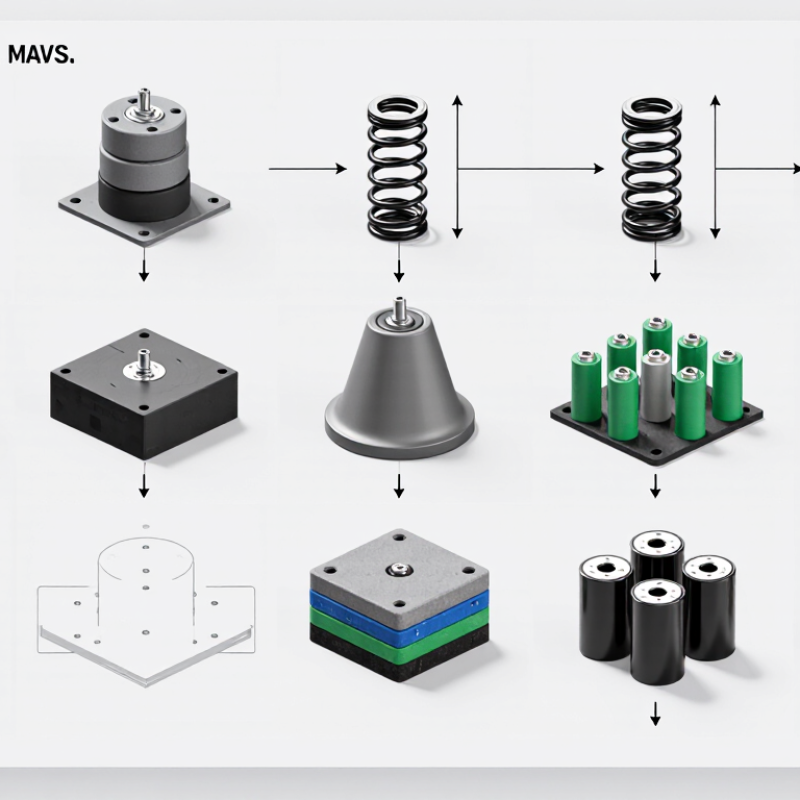
Isolation mounts are mechanical elements that reduce vibration transfer between a machine and its supporting structure. They sit beneath motors, pumps, compressors, instruments, or equipment frames. Their flexibility creates a controlled barrier between the vibration source and the floor. This barrier can reduce noise, fatigue, and unwanted movement. Small details matter.
Effective isolation depends on stiffness, load, damping, and operating frequency. A mount should support the equipment without becoming rigid under its weight. Engineers often compare the mount’s natural frequency with the machine’s forcing frequency. Isolation improves when the forcing frequency is sufficiently higher than the natural frequency. Damping helps control resonance during startup and shutdown. Too much damping, however, may reduce isolation at higher frequencies. The correct balance is not always obvious.
In field work, I have seen vibration problems blamed on bad mounts when uneven loading caused the real issue. A machine weighing 400 kilograms may need four mounts, but equal spacing does not guarantee equal load. Measure the actual weight distribution when possible. Check compression, bolt condition, floor flatness, and temperature exposure. Rubber compounds can stiffen in cold rooms and soften near heat sources. Metal springs may offer better low-frequency isolation, while elastomers usually provide simpler installation and useful damping. I would still avoid selecting a mount from a catalog load rating alone. Testing often reveals assumptions that looked reasonable on paper.
Comparison of commonly used isolation mount designs based on vibration frequency, load capacity, static deflection, installation needs, and typical applications.
| Rank | Isolation Mount Type | Typical Load per Mount | Typical Natural Frequency | Typical Static Deflection | Best-Suited Applications | Main Advantages | Key Limitations | Overall Suitability |
|---|---|---|---|---|---|---|---|---|
| 1 | Steel Coil Spring Mount | 450–22,500 kg (1,000–50,000 lb) | 2–5 Hz | 25–100 mm (1–4 in) | Large HVAC equipment, chillers, pumps, compressors, generators, and industrial machinery | High load capacity, long service life, strong low-frequency isolation, and adjustable designs are available | Requires lateral restraint or stable equipment support; may transmit high-frequency noise without an auxiliary pad | ★★★★★ |
| 2 | Air Spring Mount | 225–45,000 kg (500–100,000 lb) | 1–3 Hz | 50–150 mm (2–6 in) | Precision machinery, optical equipment, test platforms, semiconductor tools, and high-performance laboratories | Excellent low-frequency isolation, automatic leveling capability, and low transmitted vibration | Needs a clean compressed-air supply and level-control equipment; vulnerable to puncture and air leakage | ★★★★★ |
| 3 | Elastomeric Rubber Mount | 5–4,500 kg (10–10,000 lb) | 10–25 Hz | 1–8 mm (0.04–0.31 in) | Motors, fans, pumps, vehicle components, light machinery, and general equipment isolation | Compact, economical, maintenance-free, and effective for medium- and high-frequency vibration | Performance changes with temperature, aging, oil exposure, and load; less effective at very low frequencies | ★★★★★ |
| 4 | Wire Rope Isolator | 10–1,800 kg (20–4,000 lb) | 8–30 Hz | 2–15 mm (0.08–0.59 in) | Electronic cabinets, marine equipment, mobile systems, defense equipment, and shock-sensitive instruments | Resistant to oil, chemicals, ozone, corrosion, and extreme temperatures; tolerates multi-axis motion | Usually costs more than basic rubber mounts and may require careful load-direction analysis | ★★★★☆ |
| 5 | Neoprene Isolation Pad | 45–4,500 kg (100–10,000 lb) | 15–30 Hz | 1–3 mm (0.04–0.12 in) | Air-handling units, small pumps, compressors, piping supports, and building-service equipment | Simple installation, good resistance to moisture, and effective reduction of structure-borne vibration | Limited low-frequency isolation and limited vertical travel; load distribution must be checked | ★★★★☆ |
| 6 | Spring-Isolated Hanger | 10–900 kg (20–2,000 lb) | 3–8 Hz | 12–40 mm (0.5–1.6 in) | Suspended pipes, ductwork, fans, pumps, ceiling-mounted equipment, and building services | Reduces vibration transferred through suspended structures and helps isolate overhead equipment | Requires adequate structural support and sway control; installation alignment is important | ★★★★☆ |
| 7 | Viscoelastic Constrained-Layer Mount | 5–1,350 kg (10–3,000 lb) | 8–25 Hz | 0.5–4 mm (0.02–0.16 in) | Control panels, precision enclosures, electronics, machine guards, and systems requiring added damping | Provides damping as well as isolation and can reduce resonance amplification in lightly damped structures | Temperature- and frequency-dependent behavior; generally not suitable for very high static loads | ★★★★☆ |
| 8 | Cork-Rubber Composite Pad | 45–2,250 kg (100–5,000 lb) | 20–40 Hz | 0.5–2 mm (0.02–0.08 in) | Machine tools, small motors, gearboxes, transformers, and equipment on rigid foundations | Easy to cut and install, good damping, and suitable for moderate loads where space is limited | Provides modest low-frequency isolation and may creep or compress under sustained heavy loading | ★★★☆☆ |
| 9 | Hydraulic Damped Mount | 25–900 kg (50–2,000 lb) | 8–20 Hz | 2–8 mm (0.08–0.31 in) | Engines, reciprocating machinery, vehicle systems, and equipment with strong resonance or impact forces | Combines elastic support with fluid damping and can control transient shocks and resonant motion | More complex than solid elastomer mounts; fluid leakage, aging, and temperature effects must be considered | ★★★★☆ |
| 10 | Seismic Restraint Isolation Mount | 225–9,000 kg (500–20,000 lb) | 3–10 Hz | 10–50 mm (0.4–2 in) | Critical HVAC equipment, pumps, generators, rooftop machinery, and equipment in earthquake-prone areas | Balances vibration isolation with equipment restraint during seismic or high-wind events | Restraint hardware can reduce isolation performance if incorrectly adjusted; structural anchoring is required | ★★★★☆ |
Selection note: Values are representative engineering ranges rather than guaranteed product ratings. Actual performance depends on mount geometry, material, temperature, loading direction, excitation frequency, equipment center of gravity, and installation quality. For effective isolation, the mount's natural frequency should normally be well below the disturbing frequency.
