ClickCease

China Top Rear End Differential Manufacturers Guide

Choosing a reliable rear end differential manufacturer requires more than comparing catalog prices. It demands practical engineering judgment, verified production data, and attention to vehicle application. China has become a significant manufacturing base for automotive driveline components. Its suppliers range from large, internationally audited factories to smaller workshops with limited testing records.

A rear end differential must manage torque, wheel-speed differences, heat, noise, and long-term fatigue. These demands become visible during real driving. A loaded pickup climbing a wet road stresses the gear teeth differently from a passenger car cruising on a highway. Gear material, machining accuracy, bearing preload, sealing quality, and final inspection all matter. So does technical communication after delivery.

Carroll Smith, a respected race-car engineer and author, wrote, “Any damn fool can make something complex; it takes a genius to make something simple.” His observation applies directly to differential sourcing. The best manufacturers do not hide weak processes behind complicated specifications. They explain their tolerances, testing methods, warranty terms, and installation requirements clearly.

This guide examines leading Chinese rear end differential manufacturers through an evidence-based lens. It considers manufacturing experience, engineering capability, certifications, customization support, export reliability, and customer feedback. Some supplier information may change. Factory claims also deserve independent verification. That is an uncomfortable but necessary point.

Expect practical comparisons, not exaggerated rankings. The strongest choice depends on axle design, torque demand, operating temperature, vehicle weight, and service conditions. A supplier suitable for light commercial vehicles may fail under heavy-duty use. Careful matching remains essential.
China Top Rear End Differential Manufacturers Guide

What Is a Rear End Differential?

China Top Rear End Differential Manufacturers Guide

What Is a Rear End Differential?

A rear end differential is a gear assembly inside the rear axle housing. It sends engine torque to both rear wheels. It also lets those wheels rotate at different speeds during a turn.

The outside wheel travels farther than the inside wheel. Without this speed difference, tires can scrub across the pavement. Steering would feel heavy. Gear teeth and axle shafts would also face unnecessary stress. The main parts include a pinion gear, ring gear, carrier, and side gears. Some designs add clutch packs or electronic locking controls for better traction.

That simple definition is useful, but incomplete. In workshop practice, noise can come from incorrect backlash, worn bearings, or poor lubricant condition. A humming sound during acceleration may indicate gear wear. However, sound alone cannot confirm the fault. Measurement is essential.

The U.S. EPA’s 2024 Fuel Economy Guide explains that four-wheel-drive systems often consume more fuel because of added mass and mechanical losses. This matters when manufacturers select differential ratios and housing materials. Meanwhile, the International Energy Agency’s Global EV Outlook 2025 reports more than 17 million electric cars were sold globally in 2024. Many electric rear drive units now integrate a motor, reduction gears, and differential in one compact assembly. The design direction is changing, though service fundamentals remain. Clean assembly matters. Accurate tolerances matter more.
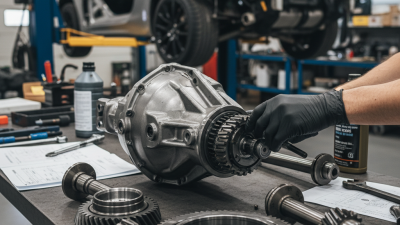
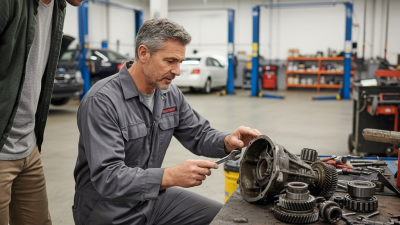
How Rear End Differentials Work in Vehicles

How Rear End Differentials Work in Vehicles

A rear end differential sits between the drive wheels and the final drive gear. It transfers engine torque through axle shafts while allowing each wheel to rotate at a different speed. This difference matters when a vehicle turns. The outside wheel travels farther, so it must spin faster. Without this movement, tires scrub across the pavement, steering feels resistant, and axle components face unnecessary stress.

Inside the housing, ring and pinion gears reduce speed and increase turning force. Spider gears then divide torque between the two axle shafts. During a gentle turn, these gears rotate smoothly. On loose ground, however, the wheel with less grip may spin quickly. Limited-slip designs reduce this problem by directing more usable torque toward the wheel with traction. A technician can often detect trouble through a humming sound, metal particles in the oil, or backlash felt during acceleration.

Manufacturing quality strongly affects service life. Accurate gear tooth geometry, controlled heat treatment, and proper bearing preload are essential. The housing must also resist distortion under heavy loads. In practice, small setup errors can create large noise problems. I have found that lubricant level is often overlooked, even though it protects gear surfaces from heat and wear. Still, no inspection replaces careful measurement with calibrated tools. A differential may appear clean outside while hidden pitting develops inside. That uncertainty deserves attention.

Key Types of Rear End Differentials in China

China’s rear-end differential market serves passenger cars, commercial vehicles, and off-road platforms. The China Association of Automobile Manufacturers reported 31.44 million vehicle sales in 2024. That volume supports diverse differential production and testing capabilities.

The open differential remains the simplest option. It distributes torque between wheels while allowing different speeds during cornering. It suits ordinary road vehicles, but traction can fall sharply on wet or uneven surfaces. Limited-slip differentials provide better control. Clutch-type units respond through friction plates, while helical units use gear geometry. Locking differentials deliver near-equal wheel torque for demanding terrain. Electronic systems add sensors and actuators, enabling faster torque management. Hypoid gearsets are also common in rear axles because they reduce noise and package efficiently. However, efficiency depends heavily on gear alignment and lubrication.

Tips: Ask Chinese manufacturers for torque curves, gear-contact reports, heat-treatment records, and endurance results. Check backlash at room temperature and after thermal cycling. CAAM production data shows scale, not automatic quality. A supplier’s inspection process matters more than its catalog size. The choice is not always clean-cut. A clutch limited-slip unit may outperform a locking unit on paved roads, yet require more maintenance. Field conditions, axle load, lubricant grade, and control software must be reviewed together. One weak assumption can distort the specification.

China Top Rear End Differential Manufacturers Guide: Key Types of Rear End Differentials in China

Rear end differentials used in China commonly include open, clutch-type limited-slip, helical or Torsen-style limited-slip, locking, and spool designs. The chart shows typical torque-bias-ratio ranges used to compare how effectively each design can transfer torque when traction differs between the drive wheels.

Torque-bias ratio is the maximum torque available at the higher-traction wheel relative to the lower-traction wheel. Actual performance depends on differential design, preload, lubrication, axle load, tire grip, and calibration. A fully locked differential is shown separately because its effective bias is not represented by a finite ratio.

China’s Leading Rear End Differential Manufacturers

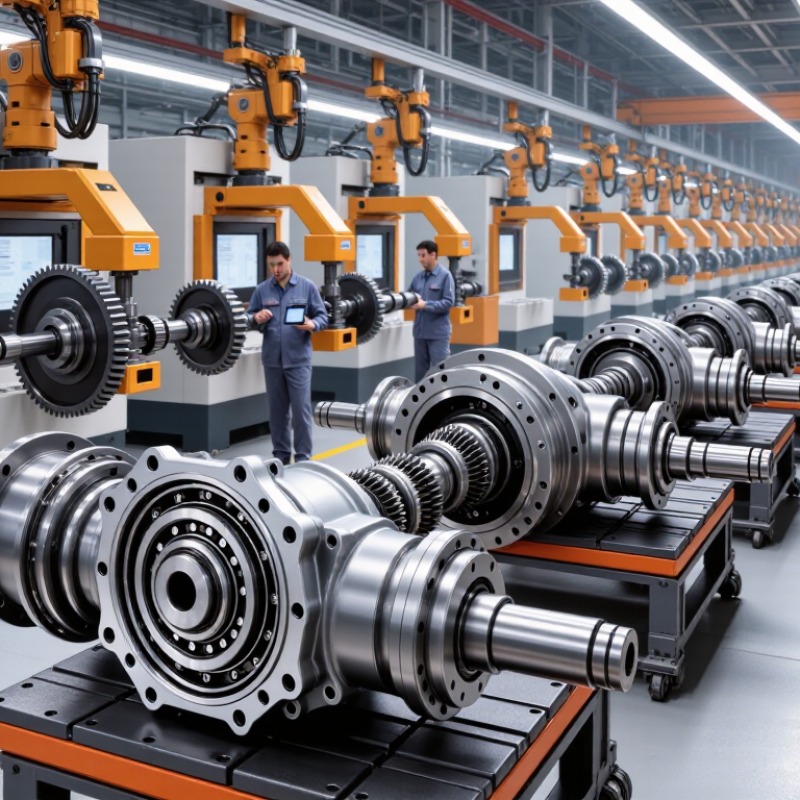
China’s leading rear end differential manufacturers serve passenger vehicles, commercial fleets, agricultural equipment, and specialized transport systems. Their experience covers hypoid gears, bevel gear sets, axle housings, and complete differential assemblies. Many factories support both standard production and engineered modifications for torque, ratio, mounting, and load requirements.

Reliable manufacturers usually combine forging, heat treatment, CNC machining, gear lapping, and controlled assembly. Engineers inspect tooth contact patterns, backlash, hardness, runout, and sealing performance. These checks matter because a small alignment error can create noise, vibration, or premature wear. Production teams also use traceable batch records and calibrated measuring equipment. That improves consistency.

Not every first sample is perfect. Real testing often reveals clearance changes under heat or uneven contact after heavy loading. Experienced suppliers revise tooling, lubrication paths, or bearing settings before approval. Buyers should request material certificates, inspection reports, durability data, and clear communication about tolerances. Factory visits can reveal practical details, such as clean assembly benches, organized parts storage, and disciplined final testing. Price alone remains a weak selection method. A lower quotation may hide limited validation, unstable machining accuracy, or incomplete after-sales support. 񟿿

China Top Rear End Differential Manufacturers Guide - China’s Leading Rear End Differential Manufacturers

Manufacturer Evaluation Dimension Rear End Differential Category Typical Technical Data or Specification Common Vehicle Applications Relevant Manufacturing or Quality Reference Recommended Verification Documents
Product Architecture Open differential Uses a differential gearset to allow the left and right wheels to rotate at different speeds during cornering. Passenger cars, light commercial vehicles, utility vehicles and standard rear-wheel-drive axles. Gear geometry, bearing capacity, backlash and lubrication design should be validated for the intended axle load. Product drawings, gear calculation reports, assembly specifications and endurance-test records.
Product Architecture Limited-slip differential Uses friction discs, helical gears or other torque-biasing mechanisms to reduce excessive one-wheel spin. Performance vehicles, off-road vehicles, pickup trucks and vehicles operating on low-traction surfaces. Torque-bias behavior, preload, clutch durability and thermal performance are key evaluation factors. Torque-bias test results, friction-material data, thermal-cycle reports and service instructions.
Product Architecture Locking differential Mechanically or electronically locks both axle shafts to improve traction when wheel slip is high. Off-road vehicles, construction vehicles, agricultural vehicles and heavy-duty utility platforms. Lock engagement reliability, actuator performance, release behavior and impact resistance should be tested. Locking-cycle test data, actuator specifications, wiring diagrams and environmental test reports.
Gear Configuration Hypoid rear axle gearset Offset ring-and-pinion arrangement designed to provide compact packaging and high torque capacity. Rear-wheel-drive passenger vehicles, SUVs, pickups and light commercial vehicles. Tooth contact pattern, hypoid offset, gear noise, lubrication and heat-treatment consistency are critical. Gear inspection reports, contact-pattern records, hardness results and noise-and-vibration test data.
Gear Configuration Spiral bevel differential Bevel gears with curved teeth that provide smooth meshing and suitable load transmission in axle systems. Special-purpose vehicles, industrial axles, agricultural machinery and selected electric-drive units. Tooth profile accuracy, surface finish, gear alignment and load distribution should be controlled. Coordinate-measuring reports, gear profile data, material certificates and load-test results.
Performance Range Final-drive ratio selection Common passenger and light-vehicle axle ratios are generally specified across approximately 2.5:1 to 5.5:1, depending on vehicle design. Passenger cars, SUVs, pickups and light commercial vehicles. The selected ratio affects acceleration, cruising speed, motor or engine speed, towing capability and energy consumption. Ratio drawings, speed-versus-rpm calculations and vehicle calibration requirements.
Materials and Treatment Alloy-steel gear and shaft components Automotive differential gears commonly use carburized or case-hardened alloy steel to combine a hard wear-resistant surface with a tougher core. Passenger vehicles, commercial vehicles, off-road vehicles and industrial axle assemblies. Case depth, surface hardness, core hardness, distortion control and metallographic structure must be monitored. Material certificates, heat-treatment charts, hardness maps and metallurgical inspection reports.
Machining Capability Gear cutting, grinding and lapping Precision gear manufacturing normally includes forging or bar preparation, heat treatment, gear cutting, finishing and tooth-contact inspection. Low-volume prototypes through high-volume automotive production programs. Process capability, machine calibration, gear measurement systems and traceability determine consistency. Process flow charts, control plans, capability studies, calibration certificates and inspection plans.
Quality Management Automotive production quality system Suppliers serving vehicle manufacturers commonly operate under ISO 9001, while automotive programs frequently require IATF 16949-based quality controls. OEM programs, Tier 1 or Tier 2 supply chains and export-oriented automotive projects. Approval status should be confirmed for the specific manufacturing site and product scope. Valid certificates, audit reports, process approval records and corrective-action history.
Validation Testing Durability, noise and thermal testing Testing may include static strength, torque cycling, thermal endurance, lubrication evaluation, backlash measurement and gear whine analysis. Passenger vehicles, electric vehicles, commercial vehicles and heavy-duty axle systems. Test conditions should reflect rated torque, peak torque, speed, lubricant temperature, duty cycle and expected service life. Validation plans, test-bench calibration records, raw data, failure-analysis reports and final test summaries.
Electric Vehicle Compatibility e-Axle or electric-drive differential Designed for integration with an electric motor, reduction gearset, differential, housing, bearings and lubrication system. Battery-electric passenger cars, electric light commercial vehicles and hybrid vehicles. High motor speed, low-noise requirements, compact packaging, thermal management and sealing are important. Motor-speed limits, efficiency maps, NVH reports, thermal tests, sealing tests and interface drawings.
Customization OEM and aftermarket engineering support Typical services include gear-ratio changes, housing modifications, mounting-interface adaptation, spline changes and differential tuning. Vehicle replacement parts, prototype programs, fleet applications and new-vehicle development. Engineering changes should be controlled through approved drawings, revision history and documented validation. 2D and 3D drawings, change-control records, prototype reports, samples and first-article inspection documents.
Export Readiness Packaging, traceability and logistics Export-ready supply normally requires corrosion protection, impact-resistant packaging, part identification and batch traceability. International aftermarket distribution, contract manufacturing and vehicle-component export programs. Packaging should protect gear teeth, machined surfaces, seals and bearing seats throughout storage and transportation. Packing specifications, labeling samples, inspection records, shipment documents and traceability procedures.

Technical values and requirements shown above are industry reference points for comparing rear end differential suppliers; final specifications must be confirmed against the target vehicle, axle load, duty cycle and approved engineering drawings.

How to Select a Reliable Chinese Differential Manufacturer

China Top Rear End Differential Manufacturers Guide

Selecting a reliable Chinese differential manufacturer requires more than comparing unit prices. OICA reported approximately 93.5 million motor vehicles were produced worldwide in 2023. China contributed about 30.16 million vehicles, according to the China Association of Automobile Manufacturers. This scale supports strong manufacturing experience, but capacity alone does not prove dependable quality. Ask for production records, engineering drawings, heat-treatment results, and traceable material certificates. A serious supplier should explain gear geometry, backlash limits, bearing preload, sealing design, and tested load cycles in clear language.

Tips: Request a sample differential before signing a large order. Inspect machining marks, gear contact patterns, oil seals, and housing flatness. Review ISO 9001 certification, but verify its scope and validity independently. Audit the factory, if possible. A video tour is useful, yet it cannot replace an in-person inspection. Require an approved inspection plan with measurable acceptance limits.

Check whether the manufacturer performs noise, vibration, durability, and leakage testing. Ask for raw test data, not only polished certificates. The 2024 Automotive Industry Action Group quality guidance emphasizes controlled processes, measurement systems, and corrective action records across automotive supply chains. These records reveal how a supplier handles failure. Be cautious when delivery promises seem perfect. Real production faces tooling wear, steel variation, and occasional rework. I would rather see a documented defect and corrective response than an empty claim of zero problems. Confirm warranty terms, spare-part support, packaging protection, and change-control procedures before approval.