Auto Repair Shop In Plainfield, IL

A Nylon Ring Nut is a fastening component designed to resist loosening on threaded bolts and studs. It usually contains a nylon ring or collar inside the nut. When tightened, the ring grips the bolt threads and creates friction. This friction helps the connection remain secure during vibration, movement, or repeated operation.
The mechanism is simple but not careless. The metal nut carries the clamping force, while the nylon section interferes with the threads. As the nut advances, the ring deforms slightly around the bolt. That contact produces prevailing torque, which helps prevent unwanted rotation. The nut still requires correct tightening. Too little torque may allow movement, while excessive torque can damage the threads or crush the nylon insert.
Small part. Important result.
In practical maintenance, a Nylon Ring Nut may appear on equipment panels, light machinery, automotive assemblies, and household hardware. Its performance depends on thread size, material compatibility, temperature, moisture, and vibration levels. Nylon can lose strength under excessive heat, so manufacturer specifications deserve attention. The nut should also be checked for damaged threads, a worn ring, or poor alignment before installation. Reusing one can be tempting, but its locking ability may decrease after removal. That detail is often overlooked. The term “nylon ring nut” can also describe slightly different designs, depending on the supplier or region. For reliable selection, compare the product drawing, thread standard, material grade, and recommended torque. A careful inspection remains more dependable than appearance alone.
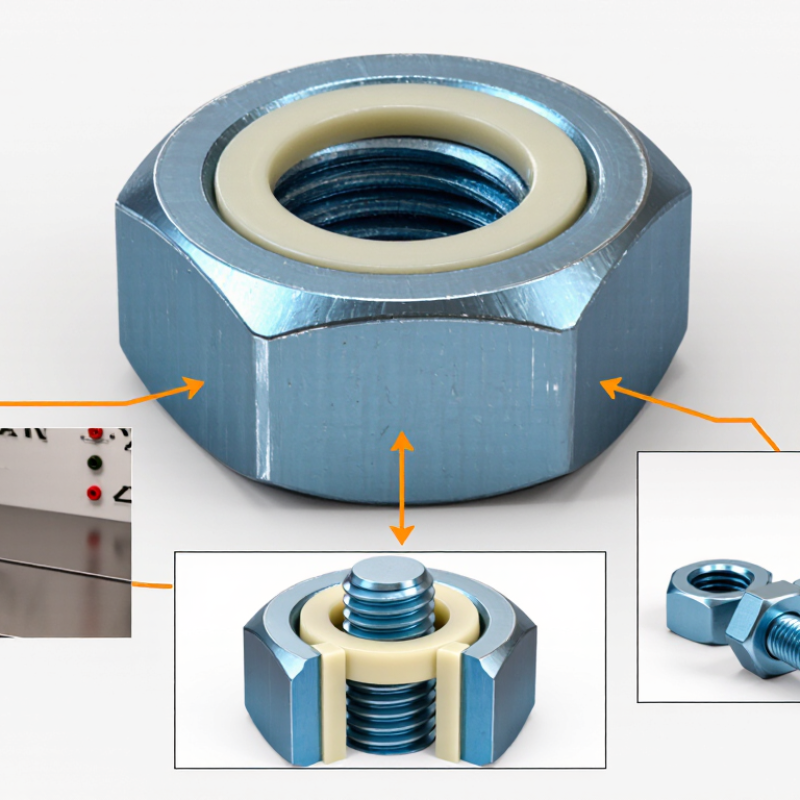
A nylon ring nut is a threaded fastener with a built-in nylon ring near its upper opening. The ring is usually smaller than the nut’s internal thread. During installation, the bolt pushes against this ring and slightly deforms it. That interference creates friction, helping resist loosening caused by vibration.
Its basic structure has three working zones: the metal body, the internal thread, and the nylon locking ring. The metal body carries the clamping load. The thread transfers torque to the bolt. The nylon ring supplies the prevailing torque. Unlike a plain nut, it should not spin freely after installation. This resistance is the key functional difference.
Material selection needs care. Nylon absorbs moisture, and its dimensions can change during storage or service. ASTM D570 evaluates water absorption, but it does not provide one universal value for every nylon grade. Conditions matter. A dry warehouse sample may behave differently after outdoor exposure. That is easy to overlook.
A 2024 Plastics Europe report recorded 413.8 million tonnes of global plastics production in 2023. Nylon fasteners represent only a small portion of that volume, yet their performance depends heavily on material control. Engineering checks should include thread fit, ring damage, installation torque, temperature, and reuse history. A ring that looks intact may have lost its locking effect. In practice, repeated removal often deserves more attention than appearance.
| Data Dimension | Typical Data or Definition | Technical Description |
|---|---|---|
| Product Definition | Metal nut with a nylon locking ring or insert | A nylon ring nut is generally a threaded metal nut containing a non-metallic nylon ring. The nylon element creates resistance against loosening when the nut is tightened onto a matching bolt. |
| Primary Function | Prevents unintended loosening | The nylon ring produces friction and interference with the bolt threads, helping the joint resist loosening caused by vibration, movement, or repeated operating loads. |
| Main Body Material | Usually carbon steel, alloy steel, or stainless steel | The metal body provides the required clamping strength and carries the applied tightening load. The selected material should match the strength, corrosion, and environmental requirements of the assembly. |
| Locking Element | Nylon ring or nylon insert | The ring is positioned inside the nut near the top of the internal thread. It is normally smaller than the bolt thread crest, allowing the bolt to deform the nylon slightly during installation. |
| Thread Type | Internal metric or unified thread | Common thread systems include metric threads such as M6 × 1.0 and unified threads such as 1/4-20 UNC. The nut thread must match the bolt diameter, pitch, and thread form. |
| Common Nominal Sizes | Approximately M3 to M20 in metric applications | Nylon-insert locking nuts are manufactured in many sizes. Exact availability, dimensions, and strength ratings depend on the applicable product standard and nut design. |
| Basic External Shape | Hexagonal body with a central threaded hole | The hexagonal exterior allows installation with a standard wrench or socket. Some designs may use a flange, reduced height, or other special external geometry. |
| Installation Principle | Threaded installation with prevailing torque | As the bolt enters the nylon ring, the ring grips the bolt threads. The nut therefore requires additional turning force compared with a standard free-running nut. |
| Clamping Action | Achieved by bolt preload and joint compression | The nylon ring is not the primary source of clamping force. Proper tightening stretches the bolt and compresses the joined parts, while the nylon ring mainly helps maintain resistance to rotation. |
| Prevailing Torque | Present before the nut reaches the clamped joint | Prevailing torque is the resistance required to rotate the nut while the nylon insert is engaged but before significant clamping pressure is applied. Its value varies with size, design, temperature, and reuse. |
| Reusability | Limited and application-dependent | Repeated removal and installation can reduce the nylon ring's locking effectiveness. The nut should be inspected and replaced when the prevailing torque or locking performance no longer meets the required specification. |
| Temperature Consideration | Lower temperature capability than an all-metal locknut | Nylon properties change with heat. The permitted service temperature must be confirmed for the specific nylon material and nut design; high-temperature applications often require a different locking method. |
| Chemical and Environmental Resistance | Dependent on both the nylon and metal materials | Moisture, oils, fuels, solvents, ultraviolet exposure, and chemicals can affect nylon or the metal body. Material compatibility should be checked before use in demanding environments. |
| Advantages | Vibration resistance, simple installation, and low added complexity | Nylon ring nuts are compact, widely available, and easy to install with ordinary tools. They also reduce the risk of metal-to-metal galling at the locking interface. |
| Limitations | Heat sensitivity, wear, and reduced locking force after reuse | They are not ideal where temperatures exceed the nylon's rating, where strong chemical exposure is expected, or where repeated disassembly requires consistent locking performance. |
| Suitable Applications | General machinery, equipment panels, vehicles, and assemblies with moderate vibration | They are commonly used for threaded joints that need resistance to loosening but do not operate beyond the nylon insert's temperature, chemical, or reuse limitations. |
| Installation Best Practice | Use the specified tightening torque and ensure full thread engagement | The bolt should extend sufficiently through the nut to engage the nylon ring. Tightening torque should account for the nut's prevailing torque and follow the requirements of the joint design. |
| Alternative Locking Methods | All-metal locknuts, prevailing-torque nuts, thread-locking compounds, and mechanical locking devices | Alternative solutions may be more appropriate for high-temperature service, severe vibration, repeated assembly, or environments where nylon is chemically unsuitable. |
