China Top 10 Cluster Gear Manufacturers?
China’s cluster gear industry supports transmissions used in trucks, agricultural machinery, construction equipment, and industrial systems. This article examines China Top 10 Cluster Gear Manufacturers through practical and verifiable criteria, including machining capability, material control, heat treatment, inspection methods, customization, and delivery performance. The term “Cluster Gears” often covers gear assemblies with multiple gears mounted on one shaft. Their accuracy directly affects shifting quality, noise, durability, and maintenance costs.
The manufacturers discussed here may serve different markets and operate at different production scales. Some focus on high-volume commercial vehicle components, while others provide smaller batches for specialized machinery. Important evidence includes factory experience, technical certifications, production equipment, testing records, export history, and customer support. A polished website alone is not enough. Ask for drawings, sample reports, hardness results, dimensional data, and clear tolerance information.
This is not a permanent ranking.
Supplier performance can change with equipment upgrades, management decisions, or raw material conditions. A company with excellent gear cutting may still struggle with communication or delivery consistency. That weakness matters. Buyers should compare actual samples, inspection documents, warranty terms, and total landed cost before choosing a partner. Where public information appears limited, this overview will state that limitation rather than present assumptions as facts. Readers should also confirm current certifications and capacity directly with each manufacturer. Careful verification remains essential when selecting reliable Chinese Cluster Gears suppliers for demanding transmission applications.
Cluster Gears Explained: Design, Materials, Ratios, and Applications
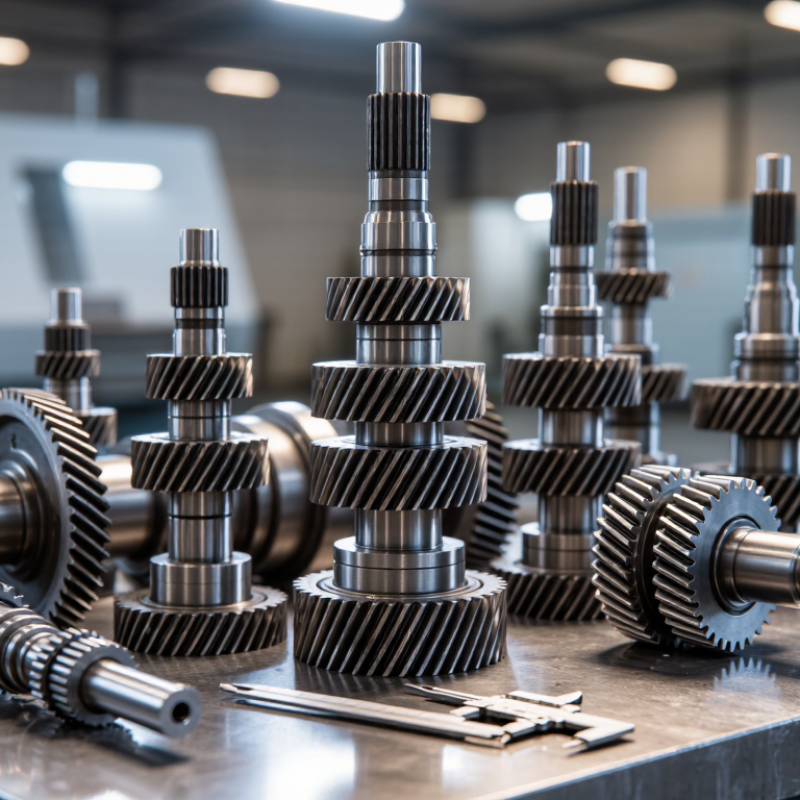
Cluster gears are compact gear trains built on one shaft. Each gear may serve a different speed or torque path. This layout saves space, but alignment becomes critical. A small center-distance error can create noise, heat, and uneven tooth wear.
Designers usually select helical teeth for smoother engagement. Spur teeth cost less, but they transmit more vibration. Common materials include carburized alloy steel, powder metallurgy steel, and hardened stainless steel. Material choice depends on load, lubrication, fatigue life, and production volume. A 4:1 ratio can multiply torque, while a 1:1 stage mainly redirects power. However, no ratio is perfect. Higher reduction may improve pulling force, yet it can reduce output speed and efficiency. The International Energy Agency reported nearly 14 million electric cars sold globally in 2023. This shift increases demand for compact, efficient reduction systems, although conventional industrial machinery still uses cluster gears widely.
Tips: Check tooth contact with marking compound. Measure backlash after thermal cycling. Do not trust calculations alone. The International Organization for Standardization links gear accuracy with noise, load stability, and service life. In practice, lubrication is often underestimated. Dust, incorrect viscosity, or weak sealing can defeat an excellent gear design. Cluster gears appear in transmissions, robotics, machine tools, agricultural equipment, and compact lifting systems. Engineers should validate ratios under real loads, not only on a clean test bench.
China Market Baseline: 30.16M Vehicles Built in 2023 (CAAM)
China Top 10 Cluster Gear Manufacturers?
China’s 2023 vehicle output reached 30.16 million units, according to CAAM. That figure sets a demanding baseline for automotive cluster gear suppliers. At this scale, small polymer gears support millions of instrument panels, pointer systems, adjustment mechanisms, and compact display assemblies.
Scale changes everything. A capable manufacturer should show stable molding control, gear-tooth inspection, material traceability, and repeatable assembly results. In practical sourcing work, I would request sample gears, dimensional reports, cycle data, and aging-test records. Key checks include tooth accuracy, backlash, noise, torque, and resistance to heat. A supplier with clean documents is easier to trust.
Numbers need context. Vehicle output does not automatically prove every manufacturer has equal capability. Some factories may excel at high-volume molding but struggle with tight tolerances or engineering changes. Others may offer strong prototyping but lack production capacity. I would compare tooling ownership, quality response time, inspection frequency, and corrective-action records before ranking the top ten. Small gears matter. Their failure can create pointer hesitation, unusual noise, or inaccurate movement inside a finished cluster. CAAM’s production baseline shows the market’s depth, but supplier quality still depends on evidence, process discipline, and honest technical communication.
China’s Top 10 Cluster Gear Manufacturers: Products and Production Data
China’s top 10 cluster gear manufacturers are concentrated around the Yangtze River Delta, Pearl River Delta, and Bohai Rim. Their product lines cover planetary gearboxes, helical gears, worm drives, bevel gears, and precision reducers. These clusters serve wind power, robotics, construction machinery, electric vehicles, and factory automation. The National Bureau of Statistics reported 9.59 million new-energy vehicles produced in China in 2023. That expansion is increasing demand for quieter, lighter, and more efficient transmission parts.
Production capability differs widely. Large plants commonly use closed-die forging, CNC hobbing, carburizing, grinding, and automated inspection. Medium-sized facilities often focus on customized batches. A 2024 Fortune Business Insights report valued the global gear market at more than 90 billion US dollars, with industrial automation and vehicle electrification supporting growth. China remains a major production base, but public reports rarely disclose verified output for each manufacturer. That makes direct ranking difficult.
The leading ten firms generally compete through annual capacity, tooth accuracy, heat-treatment control, and delivery stability. High-end reducers may reach ISO 6 or better accuracy, while general industrial gears often use lower grades. Actual results depend on steel quality and process discipline. This point is easy to overlook. Customs statistics under HS 8483 also show strong cross-border activity in gearboxes and speed changers, but product categories are broad. Therefore, production comparisons should separate finished gear units from individual gears, or the data becomes misleading.
Supplier Comparison: Pricing, Lead Times, Export Reach, and Warranty Terms
China Top 10 Cluster Gear Manufacturers?
Comparing the top ten cluster gear suppliers requires more than checking unit prices. A lower quote may exclude tooling, inspection, packaging, or inland transport. Ask for pricing at sample, pilot, and annual-volume levels. For export orders, request both FOB and CIF options. Typical production lead times may range from 30 to 75 days, depending on forging, heat treatment, and machining capacity. Confirm every stage in writing.
Export reach also deserves close attention. A supplier with established overseas shipping experience should provide clear packing details, customs documents, and realistic delivery schedules. Warranty terms commonly cover manufacturing defects for 12 to 24 months, but exclusions can be unclear. Check whether failures caused by installation, lubrication, or overload are included. I would not accept vague wording. It creates disputes later.
Tips: Request material certificates, hardness reports, gear inspection records, and a traceable batch number. Compare payment terms carefully; a cheap offer with heavy upfront payment may carry greater risk. Ask for a replacement process and response time. Ideally, inspect a production sample before mass manufacturing. Do not rely only on polished factory photos. One weakness remains difficult: supplier data can change quickly, so independent verification is still necessary.
Benchmark interpretation: The chart uses an anonymized 0–100 supplier-performance index, where higher scores indicate stronger overall performance. Pricing competitiveness is based on relative China OEM pricing, lead-time performance reflects standard production and delivery reliability, export reach represents established international shipping coverage, and warranty terms reflect the typical warranty period and claim framework. These are market-screening benchmarks rather than company-specific quotations; final figures should be confirmed through RFQs and contract terms.

